The Drive
to Produce More with Less
APO Biofertilizer is meticulously crafted from natural sources, harnessing the power of nature to optimize soil fertility, increase nutrient availability, and yield exceptional harvests.
About us
We envision a world where farmers thrive by utilizing organic biofertilizers that optimize soil health, preserve biodiversity, and protect natural resources.
Why we do, what we do
Our mission is to provide farmers with a high-quality organic-biofertilizers.
We aim to empower them to cultivate healthy, nutrient-rich crops while minimizing the ecological footprint of agriculture.

Regenerative Agriculture
Regenerative agriculture is a farming approach that aims not only to produce crops, but to restore and improve the health of the soil, water, biodiversity, and farm ecosystem while maintaining profitable farm production.
Instead of treating soil simply as a medium for holding plants, regenerative agriculture treats healthy soil as the foundation of a productive and resilient farm.

Sustainability
Increasing global population, reductions in arable land and climate change are creating an urgent need to improve farm productivity in a sustainable way.

Contract Growing
APO Agriventures Corp. provides Contract Growing opportunities to farm clusters, farmers’ associations, and cooperatives, supporting their agricultural activities through technical assistance, farm inputs, and production capitalization to increase productivity and improve income.

Climate Resilient Farming
Climate-resilient farming refers to agricultural practices and systems designed to withstand and adapt to the impacts of climate change while maintaining or improving productivity, sustainability, and food security.
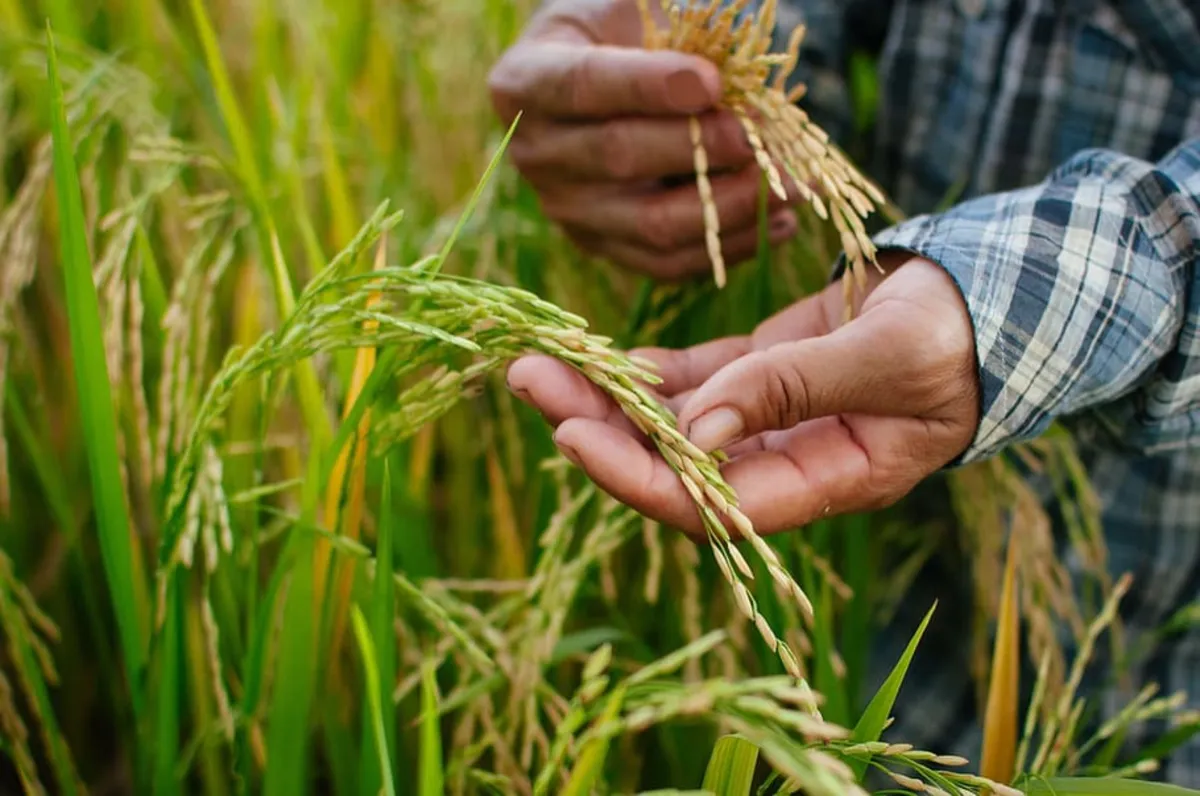
Palay Seed Production
Through our Seed Production Program, we aim to help build a stronger agricultural foundation by supporting the production and development of quality planting materials.
Why choose us?
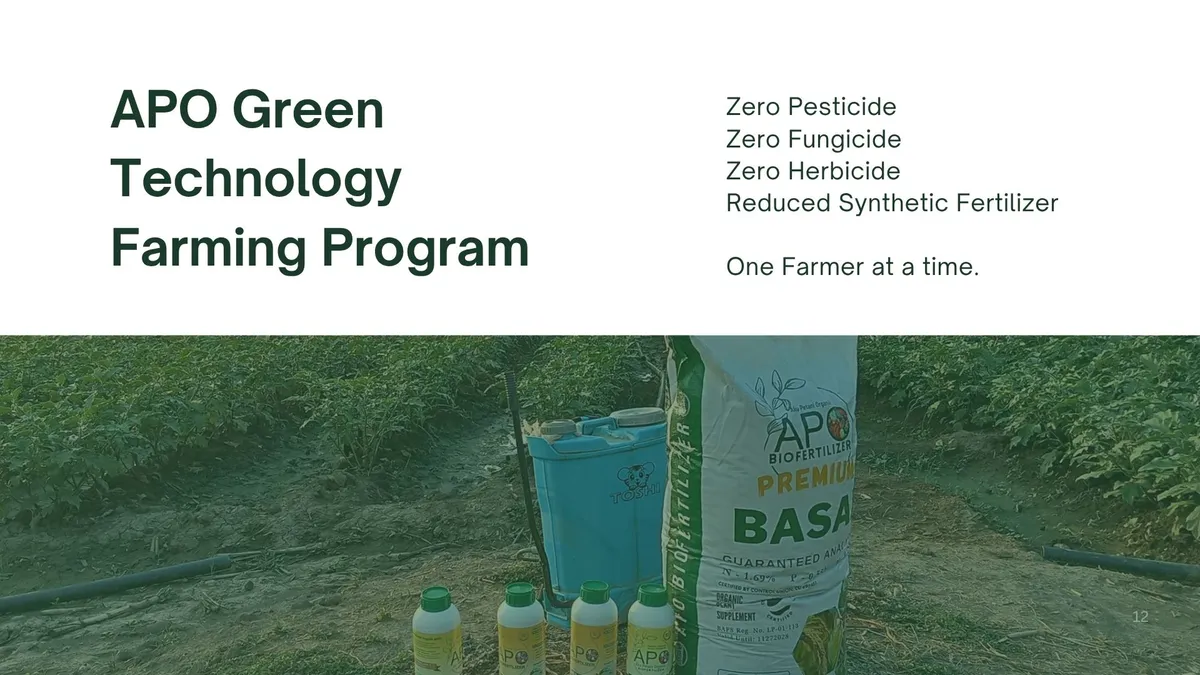
🌱 APO Biofertilizers: Growing Food Through Environmentally and Health-Friendly Green Technology Farming
Building Healthier Soil, Healthier Crops and a Healthier Future
Agriculture faces an important challenge: how can farmers continue to produce enough food while protecting the soil, water, environment and the health of farming communities?
At APO Agriventures Corp., we believe that the future of agriculture must go beyond simply increasing crop production. Farming must also protect and regenerate the natural resources that make food production possible.
This is the foundation of the APO Green Technology Farming Program—an approach designed to help farmers improve soil health, strengthen crop resilience and reduce unnecessary dependence on practices that can contribute to environmental degradation.
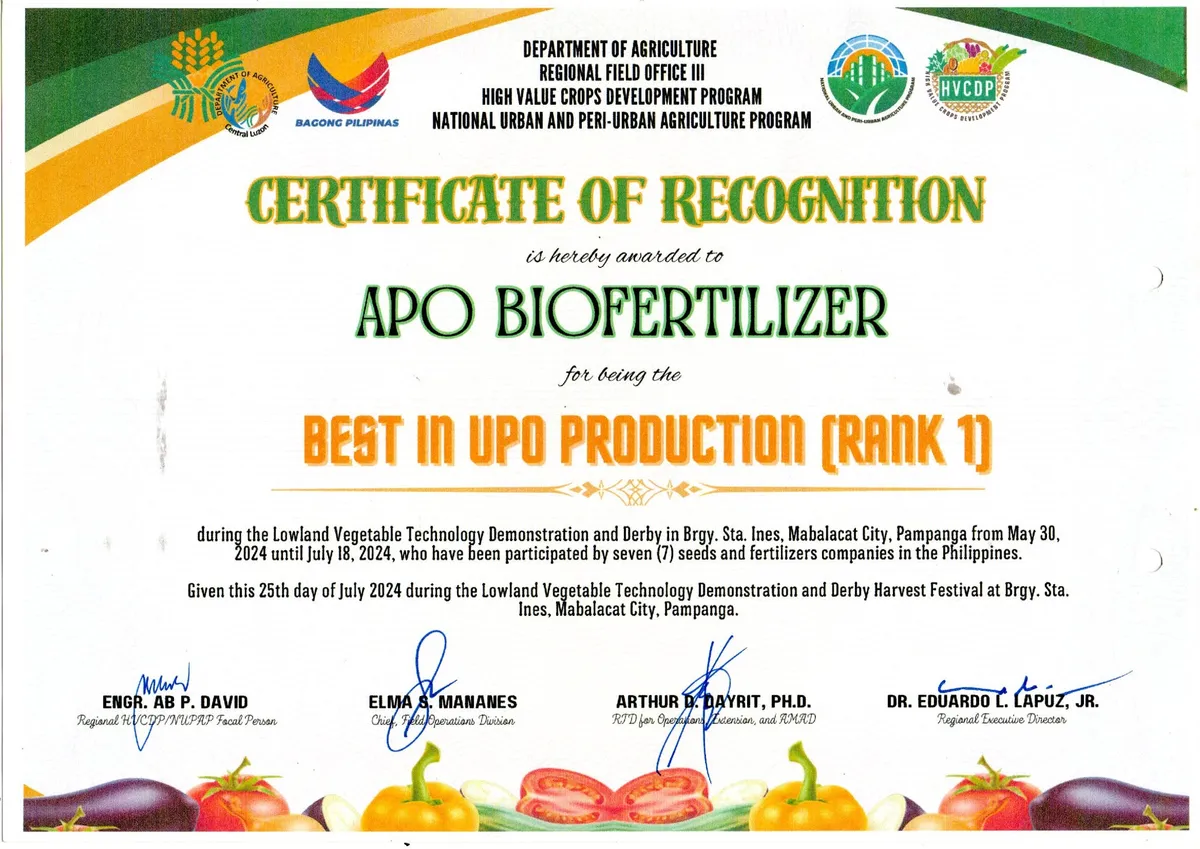
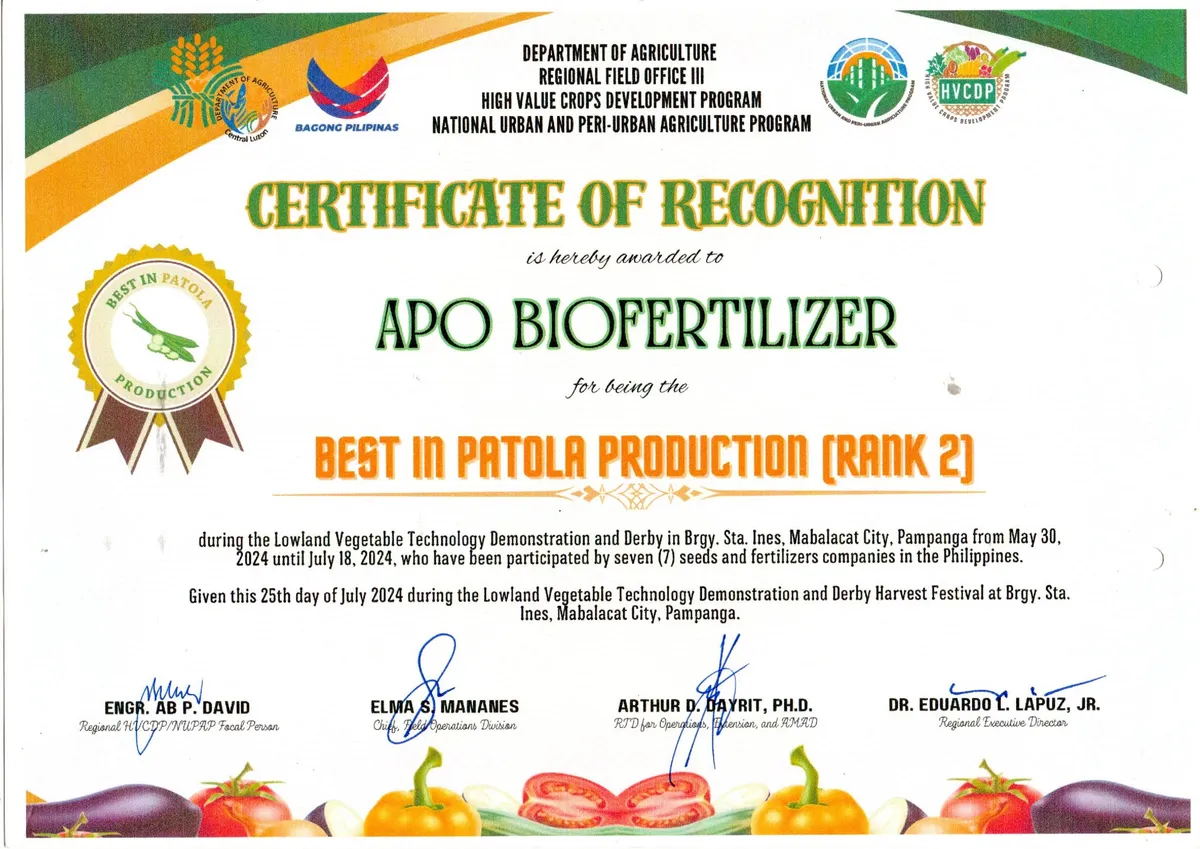
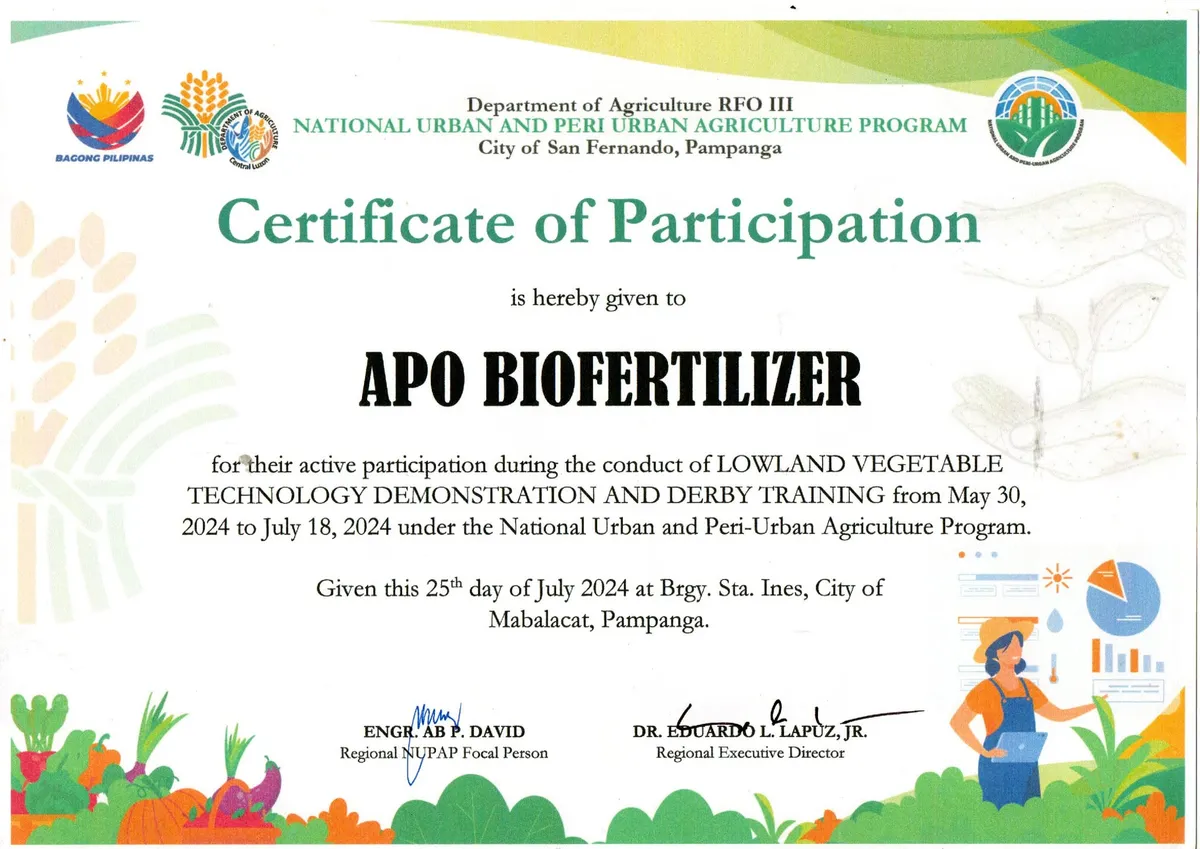
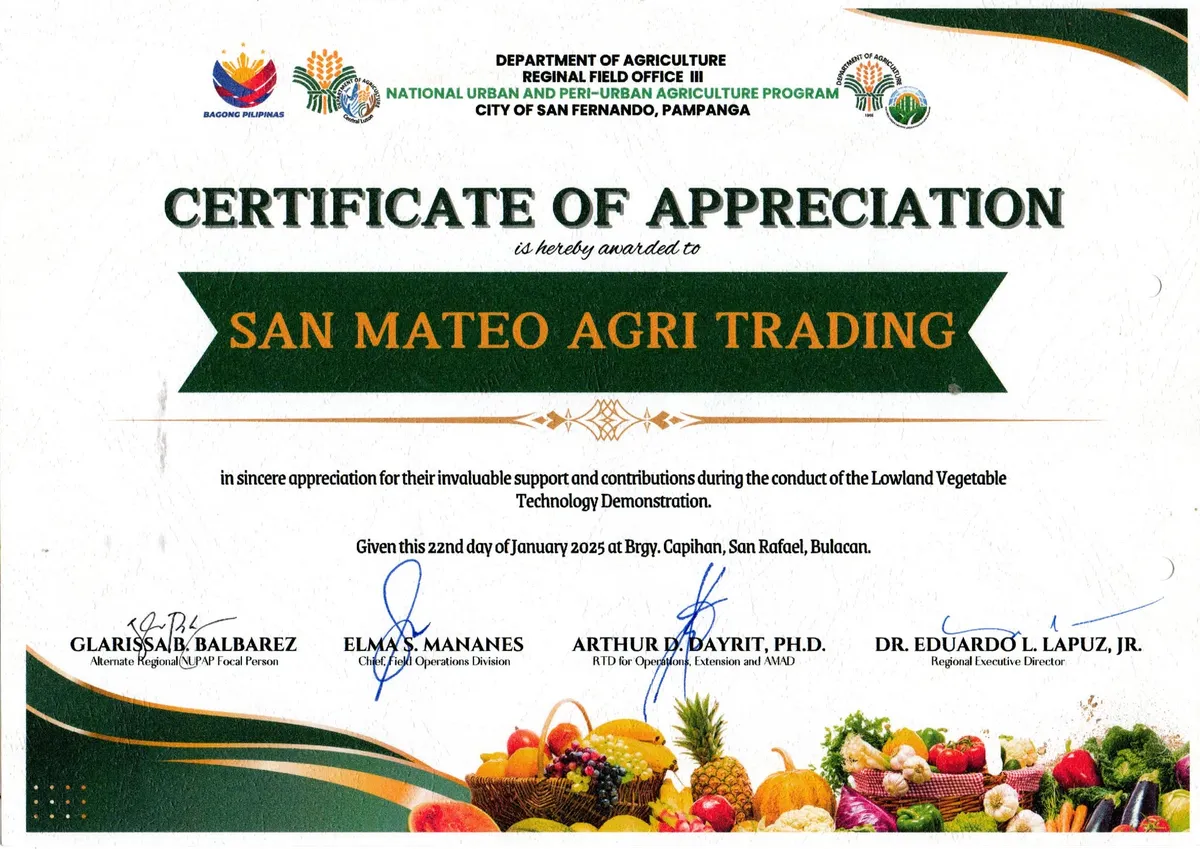
APO Biofertilizers was awarded as Most Environment and Health Friendly Product at the Lowland Vegetable Technology Demostration at Sta. Ines, Mabalacat City.
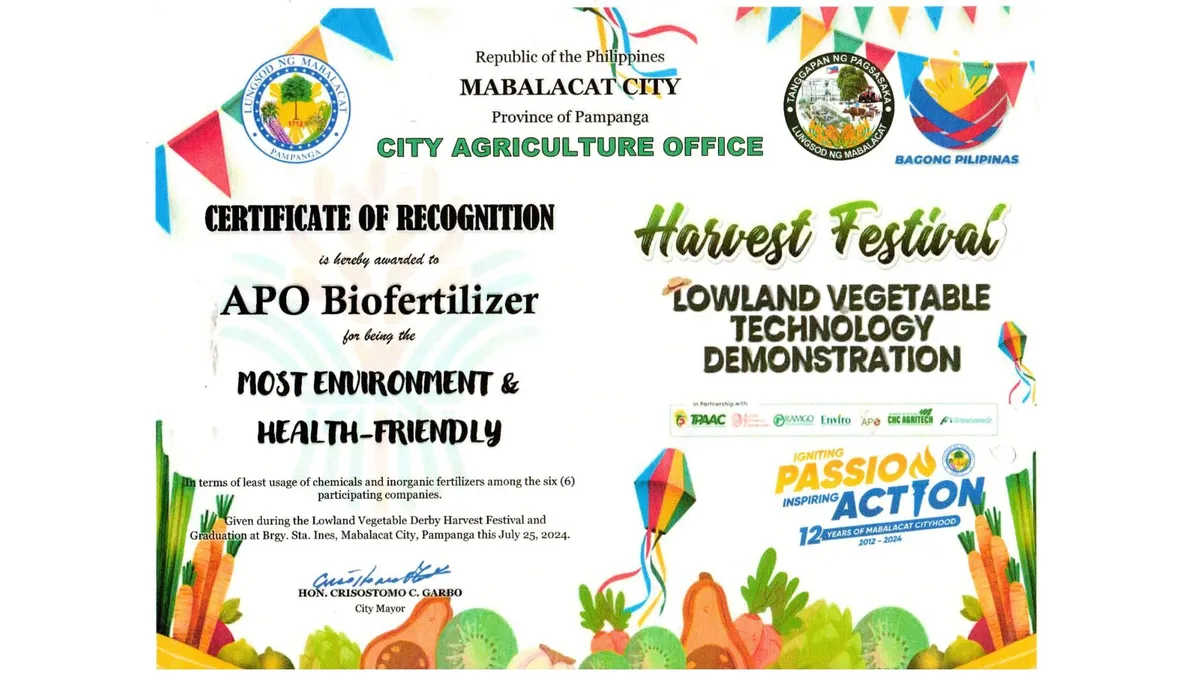
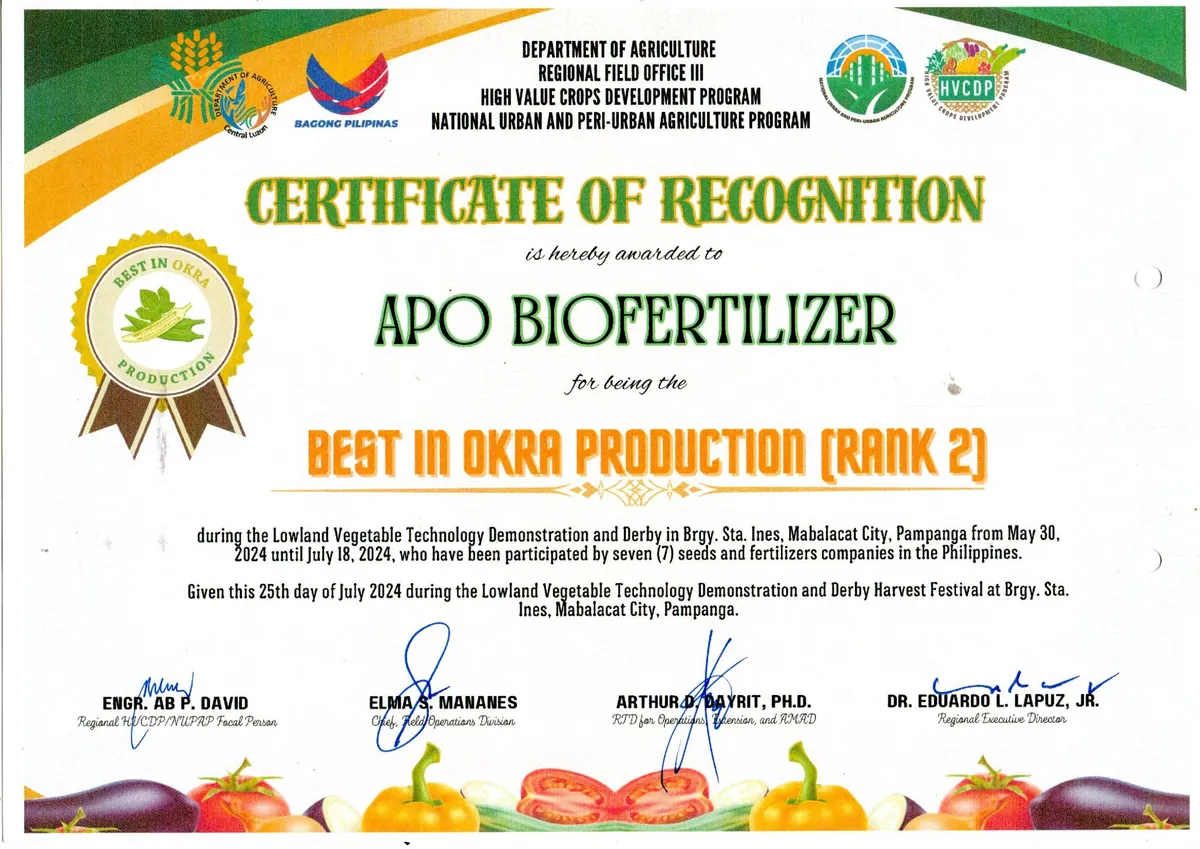
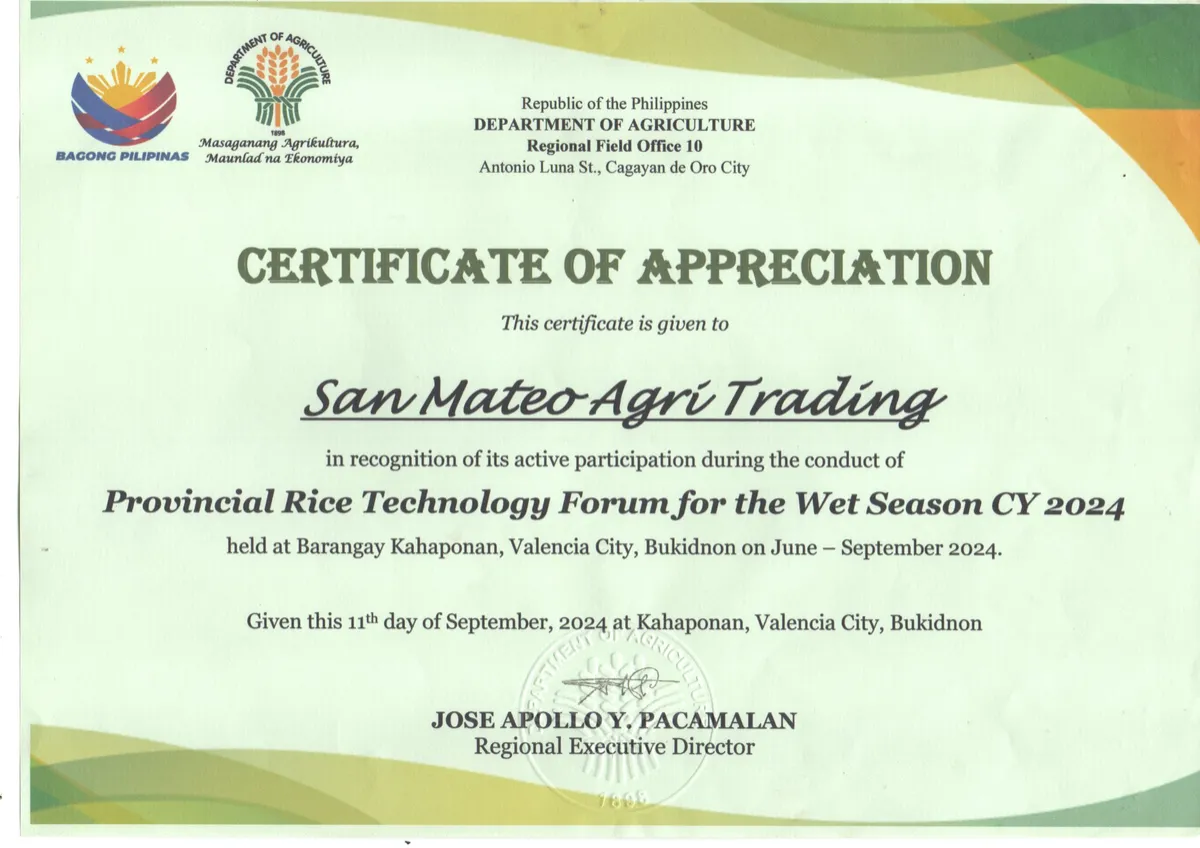
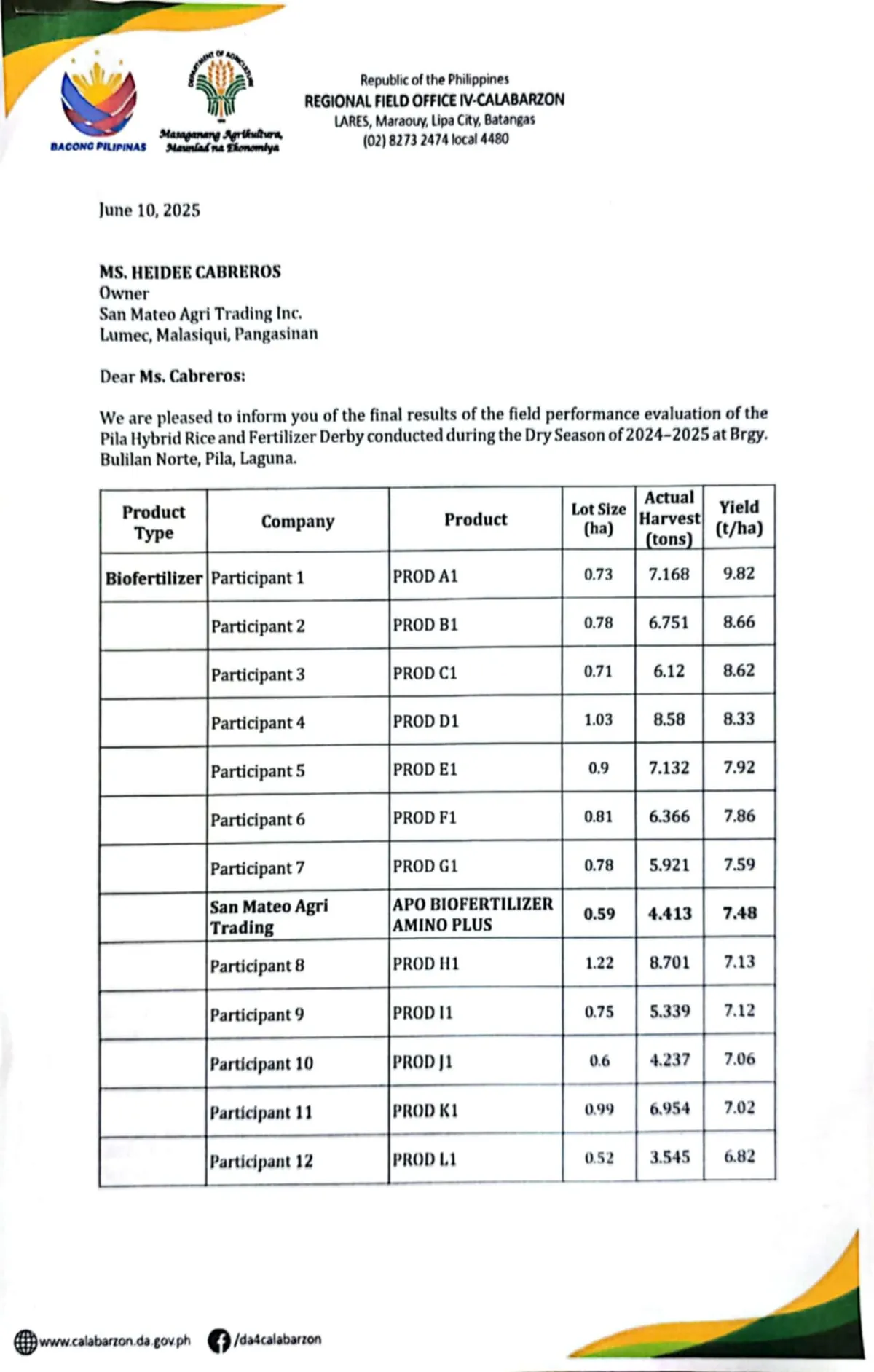
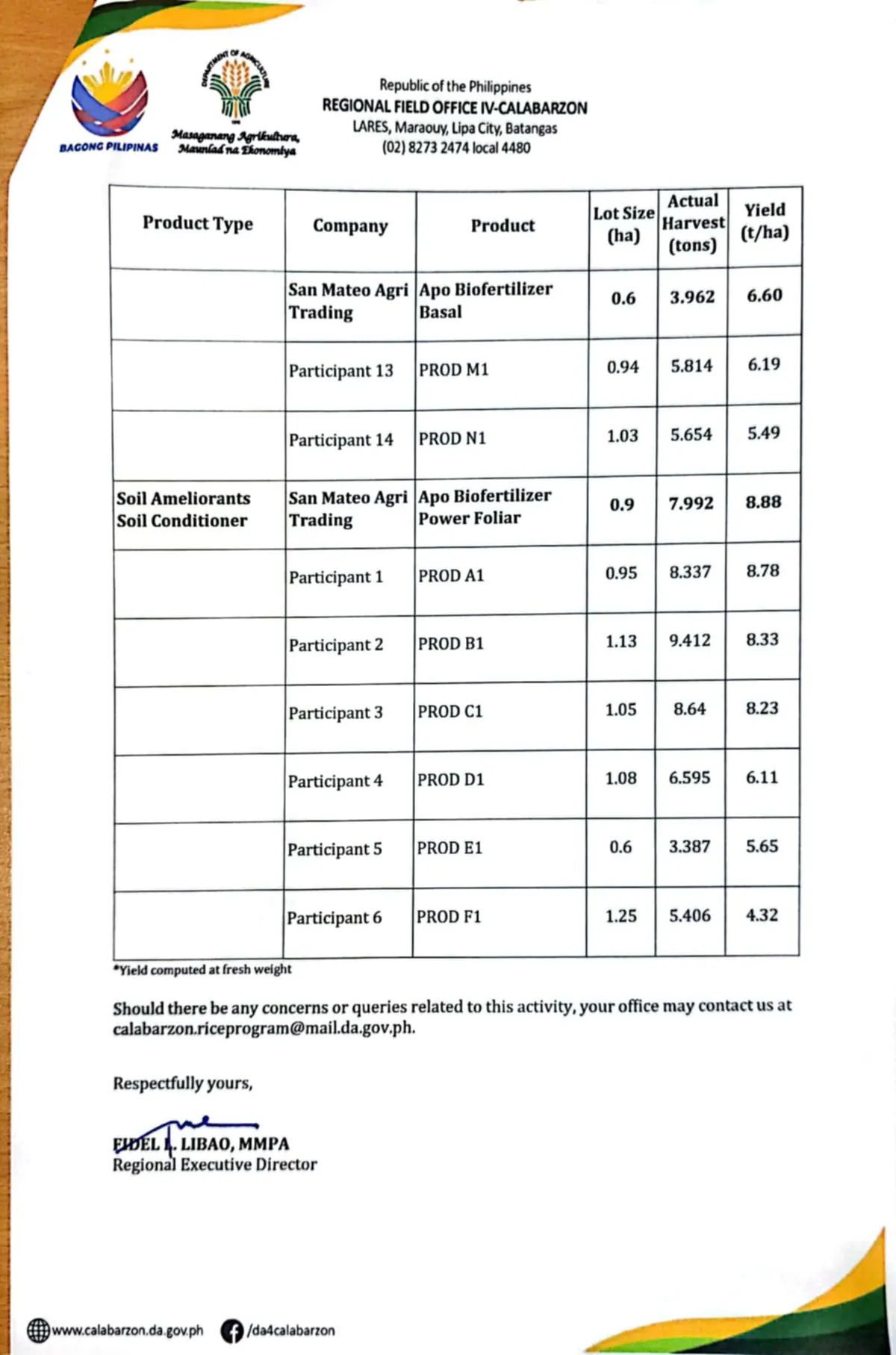
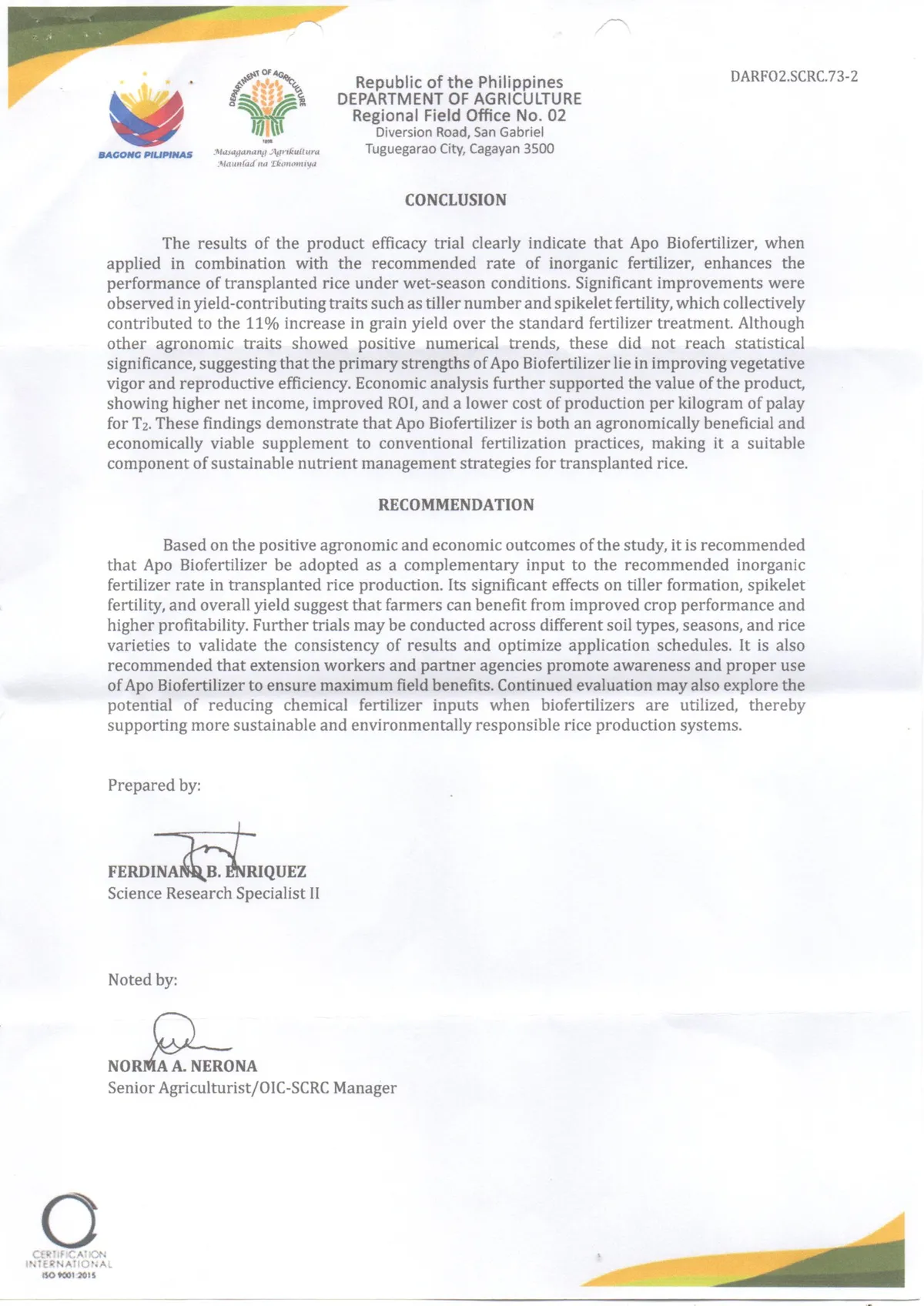
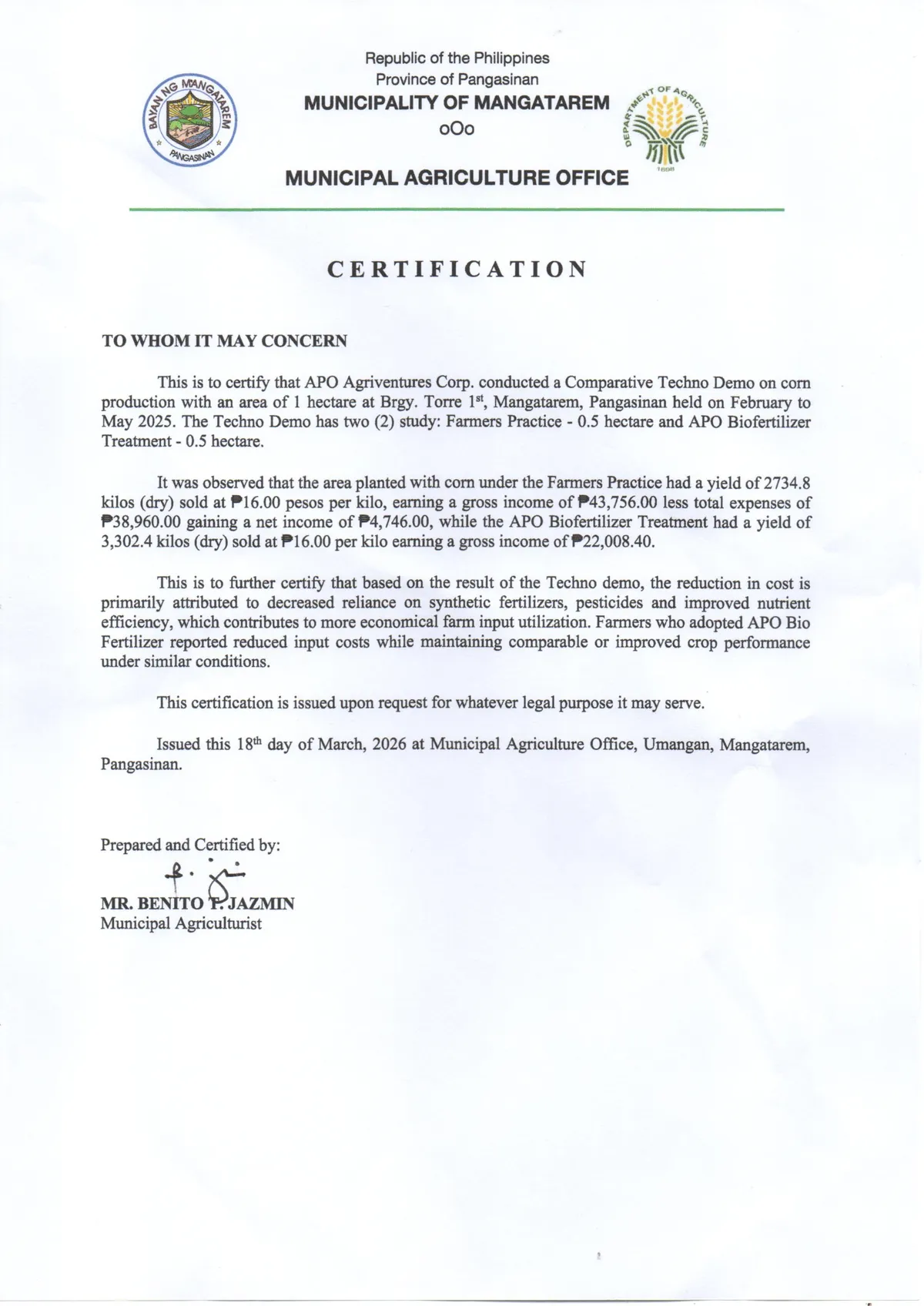
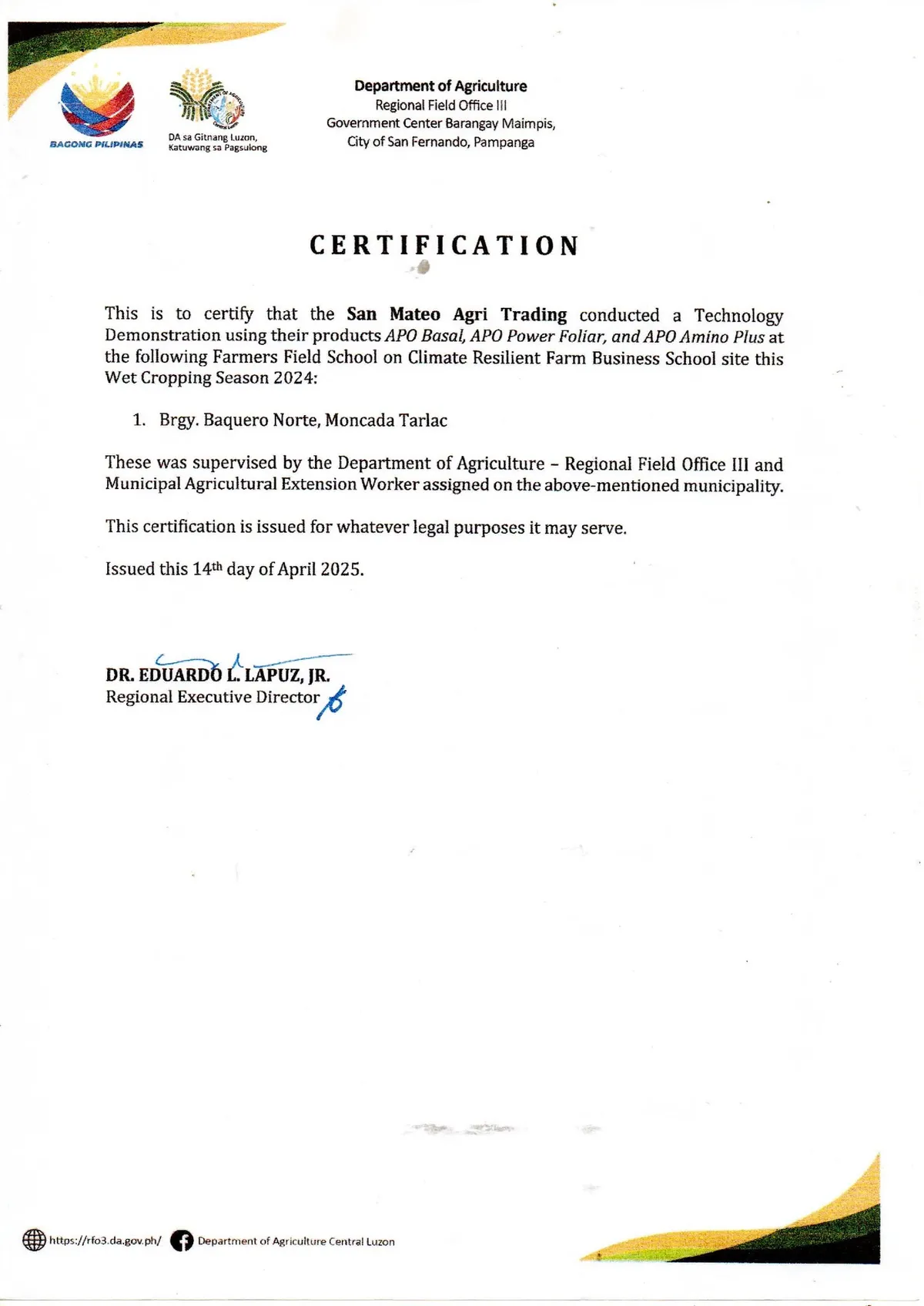
Certificate of Trials
DA Regional Techno Demo on Rice, Corn & High-Value Crop Production
Using APO Green Technology Farming Program

Testimonials
What our Farmer's say in using APO Biofertilizer products
After using 3 bags of APO Basal in my 1 hectare rice field, we have noticed after 3 days that the soil turned green.
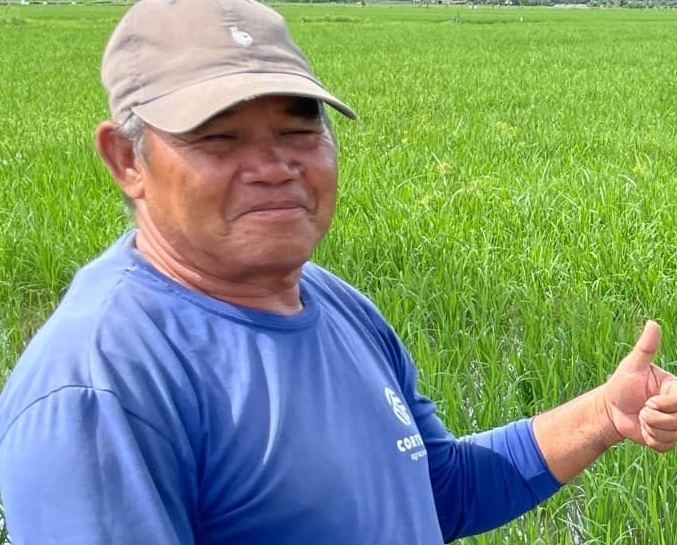
In using these biological and foliar such as APO Basal, Amino Plus, and Power Foliar, it helps cut down high expenses previously spent on synthetic fertilizers and strong insecticides.

In our field demonstrations, it shows that treated crops maintain strong growth and healthy dark green stalks—reaching heights up to 138 cm—even after being submerged in floodwaters from heavy typhoons.

I spent less, but I earned more.

The soil texture has improved and it is now more fertile due to my continuous use of APO BIOFERTILIZER.

APO products are really good. The lodged rice crops remained fresh even after a week. Meanwhile, the crops in the next field—which fell at the same time—had already rotted, resulting in total loss.

Sucess Stories of APO Farmers
The Economic Problem of Farmers When Using Chemical Fertilizers
For many farmers, chemical fertilizer is not simply an agricultural input—it is one of the largest recurring production costs. The economic problem begins when farmers become increasingly dependent on purchasing more external inputs while the efficiency and profitability of those inputs may decline over time.
1. High and Unpredictable Production Costs
Chemical fertilizers must be purchased every cropping season. Their prices can also be affected by:
International fertilizer prices
Oil and energy costs
Currency fluctuations
Import dependence
Supply-chain disruptions
This means farmers often have little control over one of their major production expenses. Even when the farm-gate price of crops remains low, fertilizer expenses must still be paid.
The farmer carries the production risk.
2. Farmers May Need to Borrow Money Before They Can Produce
Many small farmers do not have sufficient capital to purchase:
Fertilizer
Pesticides
Fungicides
Herbicides
Seeds
Fuel
Labor
As a result, production often begins with debt.
A farmer may borrow money at the beginning of the cropping season, hoping that the harvest will be sufficient to repay the loan.
But if there is:
Flooding
Drought
Typhoons
Pest infestation
Disease
Low market prices
the farmer may still have fertilizer debt even after losing the crop.
The farmer invests first, takes the production risk, and only discovers the selling price after harvest.
3. Buying More Fertilizer Does Not Always Mean More Profit
This is one of the most important economic problems.
A farmer may apply increasing amounts of chemical fertilizer expecting a proportional increase in yield. However, crop response does not always increase at the same rate.
For example:
More fertilizer applied ≠ More crop yield ≠ More farmer profit
If fertilizer costs increase faster than crop yield, the farmer's profit margin becomes smaller.
A farmer can even produce a good harvest but still earn little because production costs are too high.
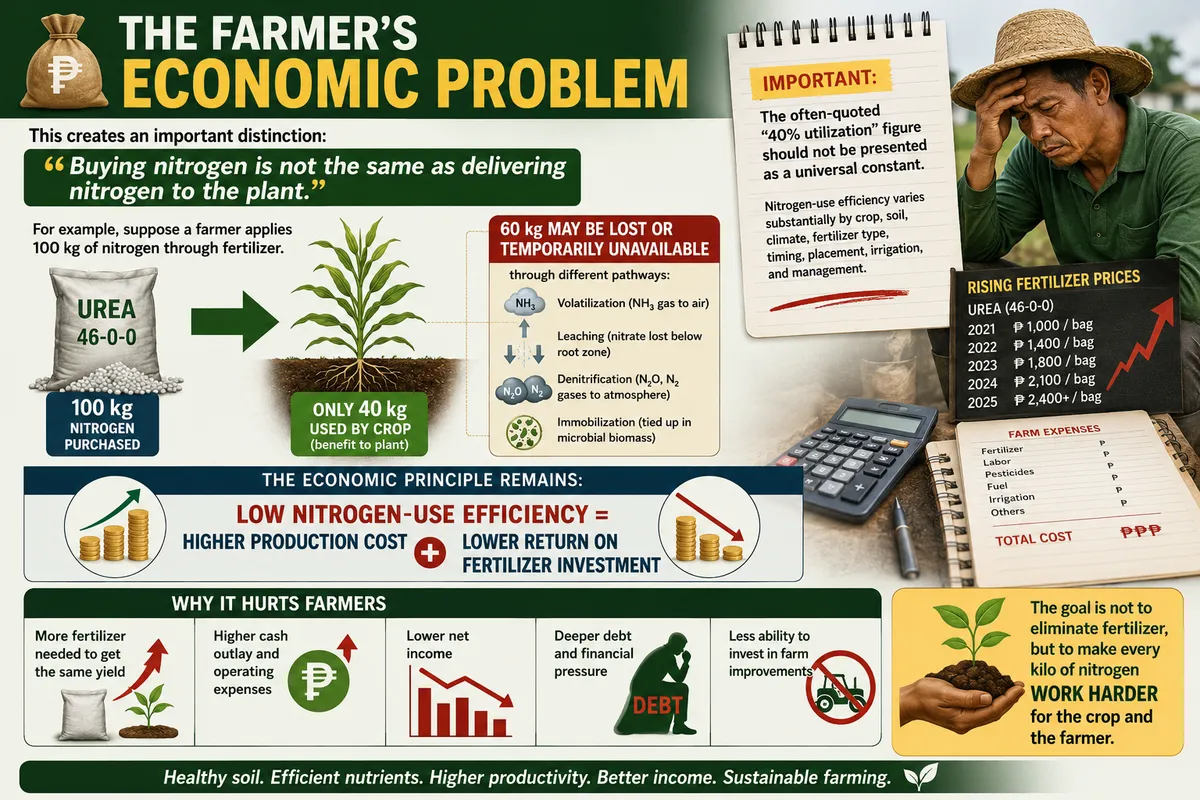
The Farmer's Economic Problem
Buying Nitrogen Is Not the Same as Delivering Nitrogen to the Plant
Suppose a farmer purchases fertilizer containing the equivalent of 100 kg of nitrogen.
Not all of that nitrogen necessarily becomes grain or biomass. Depending on soil conditions, weather, timing, and management, some nitrogen may be:
Lost to the atmosphere
Leached below the root zone
Lost through runoff
Immobilized temporarily in the soil
Converted into forms not immediately available to the crop
The economic issue is simple:
The farmer pays for 100 kg of nitrogen but may not receive the full productive benefit of 100 kg of nitrogen.
This means improving nutrient-use efficiency can be just as important economically as applying additional fertilizer.
4. Declining Soil Health Can Increase Dependence on External Inputs
Continuous dependence on highly soluble fertilizers without sufficient attention to organic matter and soil biology may contribute to a farming system where more purchased inputs are needed to maintain production.
When soil has:
Low organic matter
Poor structure
Reduced biological activity
Weak water-holding capacity
farmers may become more vulnerable to drought, heavy rainfall, nutrient losses, and crop stress.
The result can become an economic cycle:
Higher Input Dependence → Higher Production Cost → Higher Financial Risk
This does not mean that all chemical fertilizer use automatically destroys soil or that farmers should immediately eliminate synthetic fertilizers. The economic challenge is overdependence and inefficient use.
5. Chemical Fertilizer Can Create a Cash-Flow Problem
Fertilizer is purchased before income is generated.
The farmer spends money at:
Beginning of the Season
💰 Seeds
💰 Fertilizer
💰 Chemicals
💰 Labor
💰 Land preparation
But income only comes:
After Harvest
🌾 Crop production → Market → Payment
This creates a major cash-flow gap.
If the crop fails, the farmer may have:
❌ No harvest income
❌ Existing debt
❌ Interest payments
❌ Another production season approaching
The Real Problem: Rising Cost, Uncertain Returns
The farmer's profitability can be expressed simply as:
Profit = Crop Income − Total Production Cost
If chemical fertilizer and other external input costs continue to increase while crop prices remain stagnant, the farmer's profit decreases.
Even when yield increases, the farmer may ask:
"Did my income increase—or did my expenses simply increase?"
This is the difference between high production and high profitability.
A More Sustainable Economic Direction
The long-term opportunity is not necessarily to remove all synthetic fertilizer immediately. Instead, farmers can work toward a system that improves:
🌱 Soil Health
More organic matter and improved soil biological activity.
💧 Nutrient Efficiency
Helping crops utilize nutrients more effectively.
🌾 Crop Resilience
Improving the capacity of the production system to withstand environmental stress.
💰 Reduced Input Dependency
Reducing unnecessary fertilizer and chemical applications where agronomically appropriate.
📈 Higher Return on Investment
Focusing not only on maximum yield, but on:
Maximum profitable yield per peso invested.
How This Relates to APO's Green Technology Farming Program
For the APO Green Technology Farming Program, the economic message can be framed as:
The goal is not simply to replace one fertilizer with another. The goal is to help farmers reduce unnecessary dependence on expensive external inputs and remove pesticides, fungicides and herbicides while rebuilding soil health, improving nutrient efficiency, increasing crop resilience, and improving profitability.
A regenerative approach combining organic soil amendments, biological activity, improved nutrient management, and careful use of external inputs can potentially help shift the farmer's economic model from: Buy More Inputs → Spend More Money → Take More Risk toward: Build Better Soil → Improve Nutrient Efficiency → Reduce Unnecessary Inputs → Improve Farm Resilience → Protect Farmer Profit
The ultimate objective should not only be higher yields. It should be a farming system where farmers keep more of what they earn. 🌾💰
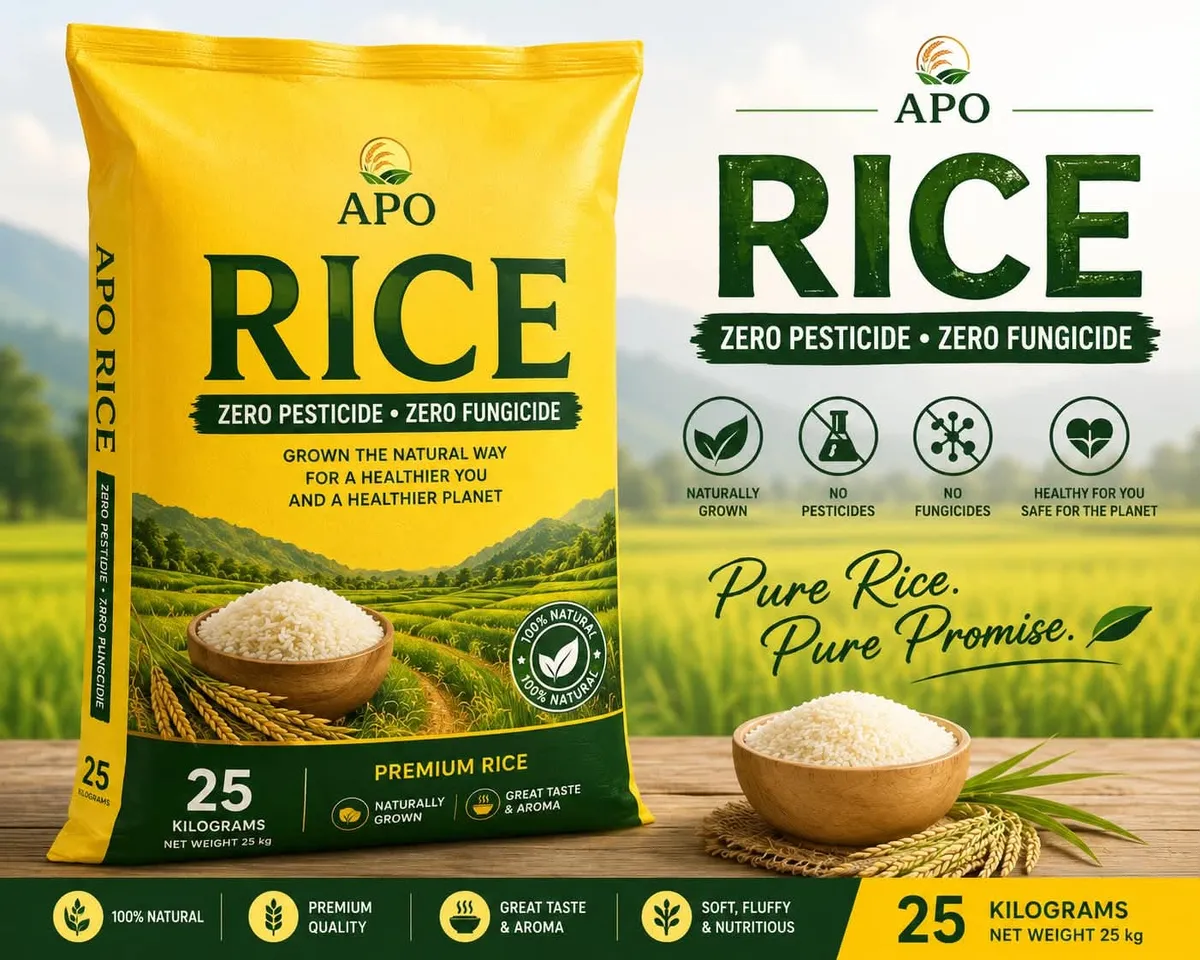
We produce Health-Friendly Rice
From Contract Growing - Regenerative - Green Farms to Healthier Tables.

It is how we till our precious lands today,
that will determine our future in farming.
APO AGRIVENTURESHJGJCORP.
0999.889.8266 | 0943.143.3637-38
APO Farm & Plant, Lunec, Malasiqui, Pangasinan, Philippines 2421
© APO BIOFERTILIZER 2022 - All Rights Reserved.